
Hexout - Color Hexa Puzzle
MetajoyPuzzle
4.9937.00 Reviews
- Version
- 0.0.43
- Installs
- 100.00K
- Age Rating
- Everyone
Screenshots
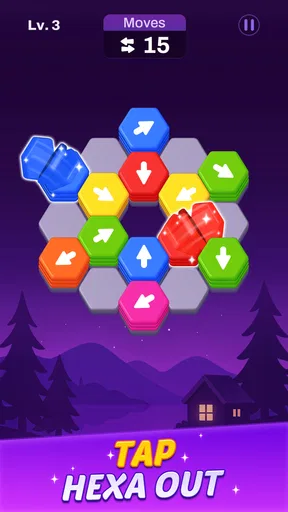
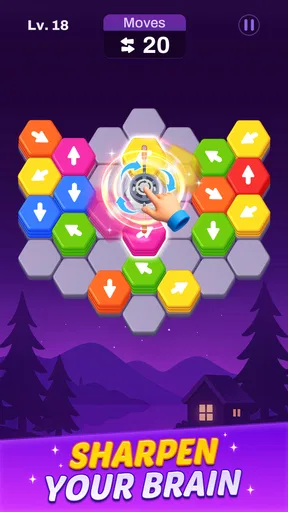
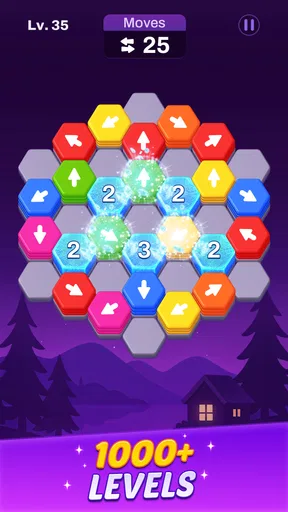


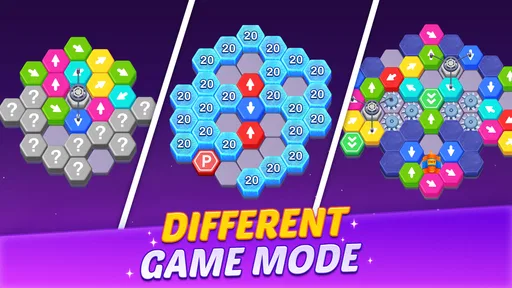
Our Review of Hexout - Color Hexa Puzzle
 Analysis by Appyee
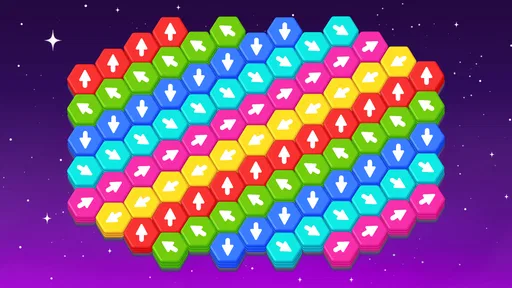
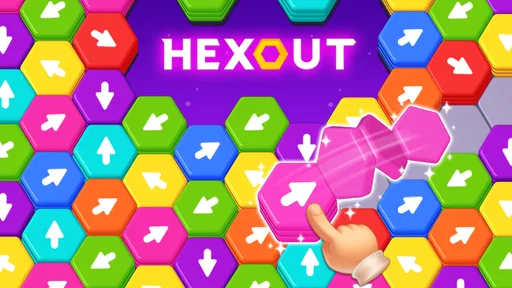
I approached Hexout - Color Hexa Puzzle as a quick puzzle game rather than something designed to occupy an entire evening. Its central idea is easy to understand: colored hexagon tiles sit on a board, and I tap them so arrows guide them away. That simplicity is exactly what makes the game approachable, but it also means the quality of each level depends on how well the layout makes me think before I move.
Developed by Metajoy, this free puzzle game is aimed at Everyone and runs on Android devices using version 8.0 or later. It is listed in the puzzle category, with a 4.9 average from around 20K ratings and over 100K installs. Those figures suggest that the compact, tactile format has found an audience, but they do not remove the need to ask a more useful question: does this particular style of sorting puzzle suit the way you like to play?
What to consider before choosing a sorting puzzle
The first decision is about the kind of concentration you want. Hexout is not a traditional match-three game where I wait for combinations to appear, and it is not a word puzzle that rewards vocabulary. The challenge comes from reading direction, color, position, and order. I need to identify which tile can leave safely, then consider how that move changes access to the tiles around it.
That makes it a good fit for short sessions. I can pick it up while waiting for an appointment, during a commute, or between larger tasks without needing to remember a story or rebuild a complicated strategy. The board itself provides the context. Once I see the arrangement, the problem is immediately in front of me.
There is also a difference between a puzzle that tests recognition and one that tests planning. The colored hexagons make the board visually readable, but a quick glance is not always enough to find the correct sequence. I often found myself scanning the arrows first, then checking whether a tile was actually free to move. That small pause is where the game earns its place as a puzzle rather than a simple tapping exercise.
The important choice is whether you enjoy planning a sequence more than chasing speed. If your favorite mobile games are built around rapid reactions, constant rewards, or competitive scores, this may feel restrained. If you prefer a quiet board that gives you a problem and lets you work through it, the design is much more appealing.
How the core board works in practice
Each turn begins with a visual question: which hexagon should leave first? An arrow may appear to offer an obvious route, but the surrounding pieces can make that route unavailable or strategically unwise. I learned to avoid treating the nearest movable tile as automatically correct. A move can be legal and still make the remaining board harder to read.
My most useful habit was to look for dependencies. I checked which tiles were blocking others, then searched for a piece whose removal would open more than one possibility. This is more reliable than tapping through the board randomly. It also gives the game a satisfying sense of cause and effect: one well-chosen move can simplify several later decisions.
Color helps with recognition, but it is not the entire puzzle. The shape of the board and the direction of the arrows matter just as much. When several tiles share a color, I stopped grouping them mentally as one task and instead considered their individual exits. That change made difficult arrangements feel more manageable without making them easy.
The game’s strongest quality is this readable interaction. I do not need a long tutorial to understand what I am supposed to do. The board communicates the immediate objective, while the blocked paths create the deeper challenge. For a mobile puzzle, that is a sensible balance between accessibility and thought.
Small techniques that make harder boards less frustrating
One practical technique is to delay the first tap. I spend a few seconds tracing the visible arrows and identifying the pieces that appear to depend on one another. This costs almost no time, yet it prevents the common mistake of removing a convenient tile and discovering that I have closed off a better route.
A second technique is to work from the outside only when the outside piece genuinely opens space. Edge positions can look safe, but they are not automatically priorities. I found that an interior tile with a clear exit can sometimes be more valuable because it exposes several neighboring pieces. Thinking in terms of newly available space is more useful than following a fixed edge-to-center rule.
A third insight is to separate color recognition from movement planning. I first note the colors that are visually easy to confuse in a crowded arrangement, then focus on the arrow direction rather than repeatedly checking the hue. This reduces hesitation and is especially helpful when the board contains many similar-looking tiles.
When I make a poor choice, I try to identify the exact assumption that failed. Was the tile blocked, was its arrow misleading, or did its removal leave a worse bottleneck? Treating a mistake as information keeps the game from becoming a sequence of frustrated restarts. It also turns each level into a small lesson in spatial planning.
Where Hexout is strongest
The game wins on immediacy. I can understand the objective almost at once, yet the arrangement still gives me something to analyze. That combination is valuable on a phone, where a complicated ruleset can feel like work and an overly simple one can become disposable after a few minutes.
It is also well suited to players who like visual organization. Sorting is not merely cosmetic here; the board asks me to bring order to a crowded group of pieces by finding a safe sequence. The satisfaction comes from seeing the layout become clearer as each successful move removes an obstacle.
Another strength is its flexible attention level. I can play casually, using the first obvious move, or more deliberately, examining the whole board before acting. The same arrangement can therefore feel like a light distraction when I am tired and a more involved logic exercise when I am willing to concentrate.
That flexibility makes it useful in everyday situations. I would choose it for a short break when I want something interactive but do not want to commit to a long match. It is also a reasonable option for someone who finds number puzzles intimidating but still wants a game that rewards planning. The visual rules are easier to enter than a system based on equations, words, or elaborate menus.
The age rating of Everyone supports that broad accessibility. I would still judge the experience by the player’s tolerance for visual concentration, because an all-ages rating does not mean every board will feel equally comfortable. Someone who prefers very large, high-contrast elements may want to test the presentation on their own device before settling into longer sessions.
Why the free format matters to the decision
Being free makes experimentation easy. I do not have to decide in advance whether this specific style of puzzle will suit me. I can try a few boards, notice whether I enjoy the planning rhythm, and keep it only if the interaction feels satisfying.
That does not mean free automatically makes it the best choice. The real value depends on whether the game gives me enough variety in the board problems to maintain interest. A sorting concept can be enjoyable at first and then feel repetitive if every arrangement asks for the same kind of solution. I therefore see the no-cost entry as an advantage for discovery, not as a reason to ignore the game’s limits.
The current version is 0.0.43, which is worth noting for anyone who pays close attention to version history. In practical terms, I would keep the game updated through the normal store process so that I am using the current build available for my device. I would not choose it because of the version number itself; I would choose it because the basic interaction fits my preferred way to relax.
Where the design may lose some players
The same simplicity that helps the game start quickly can also become a weakness. There is no need to learn a large system, but that means the board must carry nearly all of the long-term interest. Players who need a strong narrative, character progression, or a broad collection of modes may find the experience too narrow.
I also think the game asks for patience when a layout is not immediately legible. A player can understand the rule and still feel uncertain about the correct order. That uncertainty is part of the challenge, but it may feel less rewarding to someone who expects every tap to produce obvious progress.
Color is another consideration. Because the pieces are distinguished visually, the experience may be less comfortable for players who struggle to separate similar shades. The arrows and positions provide additional information, but color remains part of the board’s identity, so this is not a minor detail for every player.
Finally, this is not the right pick for someone who wants a social puzzle experience. I would look elsewhere if my priority were direct competition, collaboration, or a narrative reason to keep returning. Hexout’s appeal is personal problem-solving: I am trying to understand one board and clear it cleanly.
How it compares with familiar alternatives
Compared with match-three games, this feels more deliberate and less dependent on spotting a chain of matching pieces. Match-three play often rewards quick pattern recognition and the excitement of cascades. Here, the main reward is a correct order of removal. I would choose Hexout when I want control and planning, while I would choose a match-three alternative when I want faster visual feedback and more immediate momentum.
Compared with sliding-block puzzles, the hexagon-and-arrow format is easier to read at the start because the intended movement is shown directly. Sliding puzzles usually make the player imagine how an open space will travel through the board. Hexout shifts the challenge toward deciding which available path to use and how each departure changes the remaining arrangement. That can feel less abstract, although it still demands careful sequencing.
Compared with nonogram or Sudoku-style games, the reasoning here is spatial rather than numerical. I do not need to mark rows, columns, or possible values. That makes it a better fit for a player who wants a visual hand-eye connection, but a weaker fit for someone who enjoys extended deduction on paper-like grids.
Compared with physically sorting games, the arrows give Hexout a clearer logic layer. The goal is not simply to arrange colors neatly; I must understand the permitted direction and the order that keeps the board moving. This adds thought without requiring a large rulebook.
Those comparisons also clarify the trade-off. Hexout is more focused than a large puzzle collection, and that focus is either its identity or its limitation. I would not replace every other puzzle game with it. I would add it when I specifically want compact, visual sequencing rather than a changing selection of mechanics.
Who should install it, and who should skip it
I recommend trying it if you like untangling a board, prefer short sessions, and enjoy the moment when a complicated arrangement suddenly becomes obvious. It is especially suitable for players who want a free entry point into logic puzzles without learning a story, a deck, or a large set of controls.
I would be more cautious if you need constant novelty, a strong sense of progression, or a competitive reason to return. The core idea is focused enough that players who tire quickly of sorting mechanics may move on even if the individual boards are well designed.
It is also not my first suggestion for someone seeking a calming game with no possibility of feeling stuck. A puzzle can be relaxing when I am in the mood to think, but the same puzzle can become irritating after a long day if I keep making moves without a plan. In that situation, a simpler matching game or a passive entertainment app may fit better.
The practical cost of switching to it
Switching from another mobile puzzle is easy at the control level. The main adjustment is mental: I have to stop looking for combinations and start looking for dependencies. Once I adopt that approach, the board becomes more readable, and I spend less time tapping pieces that only appear convenient.
There is almost no learning burden, but there is a habit to build. I recommend playing the first sessions slowly instead of trying to clear every arrangement at speed. The goal is to understand how an early removal affects the rest of the board. That habit transfers well from one level to the next and makes the game feel more intentional.
The larger cost is opportunity cost. Time spent with Hexout is time not spent with a richer puzzle collection, a story-driven game, or a competitive title. For me, it earns that time when I want a focused mental break. It does not earn it when I am looking for a complete entertainment package with several different activities.
Because it is free and has a broad age rating, the barrier to testing it is low. I would install it, play with a deliberate approach, and decide based on whether the act of planning feels rewarding. If I find myself wishing for faster action, deeper rules, or more variation, that is a clear sign that another puzzle category would serve me better.
My recommendation after playing
Hexout - Color Hexa Puzzle is a focused sorting game with a clear visual premise and enough sequencing pressure to make each board more than a routine tap. I like that it can be understood quickly while still rewarding a pause before the first move. The best moments come from spotting the piece whose removal opens the board rather than simply choosing the tile that looks easiest.
My recommendation is strongest for casual puzzle players who want a free, compact experience and enjoy visual planning. The Everyone rating and Android 8.0 minimum make it approachable for a broad range of users, while Metajoy’s current build gives interested players a straightforward way to try the concept.
I would not present it as a universal replacement for match-three games, numerical logic apps, or story-led adventures. Its appeal depends on enjoying one particular kind of problem: reading arrows, separating color groups, and finding a safe order through a crowded hexagonal layout. If that sounds satisfying, it is worth installing. If you need social play, rapid action, or constant mechanical change, I would choose a different puzzle style instead.
For my own use, it works best as a short thinking break. I open it when I want to focus on one contained challenge, take a moment to inspect the board, and make moves with a reason rather than tapping experimentally. That is a modest goal, but Hexout meets it well enough to deserve a place among the lighter puzzle games I would recommend to a friend.
Verdict
Strengths of Hexout - Color Hexa Puzzle
- Simple rules make it easy to start playing immediately.
- Short puzzle sessions fit well into quick breaks.
- Color-matching mechanics offer a relaxing gameplay experience.
- Minimalist presentation keeps attention on the puzzle board.
- Increasing difficulty provides a steady challenge for puzzle fans.
Limitations of Hexout - Color Hexa Puzzle
- Some levels may feel repetitive after extended play sessions.
- Color-heavy gameplay may be difficult for users with color vision issues.
- Progress can become frustrating when a solution is not obvious.
- Limited gameplay variety may reduce long-term appeal for some players.
- Ads or optional purchases may interrupt the overall experience.
Other Releases by Metajoy
View All
Tile Journey - Classic Puzzle
Board4.5

Zombie Roguebie: Survivor Game
Adventure4.6
Similar Picks in This Category
View All
Block Blast!
HungryStudio4.8

Braindom: Brain Games Test
Lahana Game Studio4.6

AMAZE!
CrazyLabs LTD4.6

Sudoku - Classic Sudoku Puzzle
Oakever Games4.7

Art Puzzle - Puzzle Games
Easybrain4.8

Amaze GO!
Oakever Games4.9
Frequently Asked Questions
What is Hexout - Color Hexa Puzzle?
Hexout - Color Hexa Puzzle is a relaxing yet challenging color-matching puzzle game built around hexagonal tiles. The main objective is to arrange, connect, or clear colored pieces according to the rules of each level. Its simple controls make it easy to start, while increasingly complex boards require planning, pattern recognition, and careful use of available moves.
How do you play Hexout - Color Hexa Puzzle?
Gameplay is generally based on placing or manipulating hexagonal color pieces on a board to create matching groups, complete patterns, or remove tiles. Before making a move, it is worth checking how the pieces fit together and thinking several steps ahead. The early stages work as a gentle tutorial, but later puzzles demand more precise positioning and a better understanding of color combinations.
Is Hexout - Color Hexa Puzzle free to download and play?
Hexout - Color Hexa Puzzle can typically be downloaded for free, although the exact monetization model may depend on the Android or iOS version available in your region. Free gameplay may be supported by advertisements, optional purchases, or both. Before downloading, check the store listing for information about ads, in-app purchases, and whether any features or extra content require payment.
Can Hexout - Color Hexa Puzzle be played offline?
Many puzzle sessions in Hexout - Color Hexa Puzzle may be playable without a continuous internet connection, which makes the game suitable for short breaks, travel, or commuting. However, an internet connection may still be required for advertisements, analytics, cloud synchronization, updates, or certain online features. It is best to launch the game once while connected before relying on it offline.
Is Hexout - Color Hexa Puzzle suitable for children and casual players?
Hexout - Color Hexa Puzzle is approachable for casual players because the controls are straightforward and the core concept can be understood quickly. Nevertheless, the difficulty can increase as boards become more demanding, so younger players may need help with advanced stages. Parents should also review the app’s age rating, advertising policy, and in-app purchase settings before allowing children to play.
Play our best games!


